
Shift handover checklist

Shift handover is the point where one shift passes information and responsibility for the plant to the next. The Health and Safety Executive (HSE) describes effective handover in three parts: the outgoing shift prepares, both shifts exchange the information, and the incoming shift cross-checks it as they take responsibility. HSE also says handover should be face to face and two-way, using both spoken and written communication.

This free checklist is for control rooms and 24/7 operations in energy, power, oil and gas, utilities and the process industries. Use it at each handover, or to review how handover works on your site.

Free PDF, 2 pages. No sign-up.

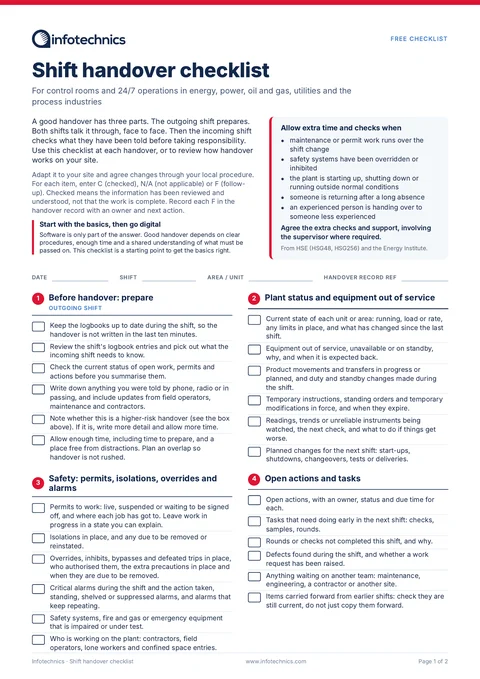
Page 1 of the Infotechnics shift handover checklist PDF

Start with the basics, then go digital

We recommend an electronic logbook and handover system such as Opralog. Every entry is timestamped and searchable, open items carry forward from shift to shift, tasks have an owner and a due date, and handovers are built in real time from what was actually recorded, rather than rushed at the end of the shift. Each shift is signed off, and changes are recorded in a full audit trail.

But software is only part of the answer. Good handover depends on clear procedures, enough time and a shared understanding of what must be passed on. Opralog helps teams follow those procedures, shift after shift, but the basics need to be right first. This checklist is a starting point to get them right.

01 / How to use it

Before you start

Three parts to every handover

A good handover has three parts. The outgoing shift prepares. Both shifts talk it through, face to face. Then the incoming shift checks what they have been told before taking responsibility. Use this checklist at each handover, or to review how handover works on your site.

Adapt it to your site and agree changes through your local procedure. For each item, enter C (checked), N/A (not applicable) or F (follow-up). Checked means the information has been reviewed and understood, not that the work is complete. Record each F in the handover record with an owner and next action.

Record at each handover: date, shift, area or unit, handover record reference, who handed over and who accepted.

Allow extra time and checks when:

  • Maintenance or permit work runs over the shift change
  • Safety systems have been overridden or inhibited
  • The plant is starting up, shutting down or running outside normal conditions
  • Someone is returning after a long absence
  • An experienced person is handing over to someone less experienced

Agree the extra checks and support, involving the supervisor where required.

Sources: HSE HSG48, HSE HSG256 and the Energy Institute.

02 / The checklist

The shift handover checklist

Eight sections, in the order a handover happens. Mark each item C (checked), N/A or F (follow-up) as you go, or download the PDF to print.

1Before handover: prepare

Outgoing shift
  • Keep the logbooks up to date during the shift, so the handover is not written in the last ten minutes.
  • Review the shift’s logbook entries and pick out what the incoming shift needs to know.
  • Check the current status of open work, permits and actions before you summarise them.
  • Write down anything you were told by phone, radio or in passing, and include updates from field operators, maintenance and contractors.
  • Note whether this is a higher-risk handover (see the box above). If it is, write more detail and allow more time.
  • Allow enough time, including time to prepare, and a place free from distractions. Plan an overlap so handover is not rushed.

2Plant status and equipment out of service

  • Current state of each unit or area: running, load or rate, any limits in place, and what has changed since the last shift.
  • Equipment out of service, unavailable or on standby, why, and when it is expected back.
  • Product movements and transfers in progress or planned, and duty and standby changes made during the shift.
  • Temporary instructions, standing orders and temporary modifications in force, and when they expire.
  • Readings, trends or unreliable instruments being watched, the next check, and what to do if things get worse.
  • Planned changes for the next shift: start-ups, shutdowns, changeovers, tests or deliveries.

3Safety: permits, isolations, overrides and alarms

  • Permits to work: live, suspended or waiting to be signed off, and where each job has got to. Leave work in progress in a state you can explain.
  • Isolations in place, and any due to be removed or reinstated.
  • Overrides, inhibits, bypasses and defeated trips in place, who authorised them, the extra precautions in place and when they are due to be removed.
  • Critical alarms during the shift and the action taken, standing, shelved or suppressed alarms, and alarms that keep repeating.
  • Safety systems, fire and gas or emergency equipment that is impaired or under test.
  • Who is working on the plant: contractors, field operators, lone workers and confined space entries.

4Open actions and tasks

  • Open actions, with an owner, status and due time for each.
  • Tasks that need doing early in the next shift: checks, samples, rounds.
  • Rounds or checks not completed this shift, and why.
  • Defects found during the shift, and whether a work request has been raised.
  • Anything waiting on another team: maintenance, engineering, a contractor or another site.
  • Items carried forward from earlier shifts: check they are still current, do not just copy them forward.

5Deviations, incidents and abnormal events

  • Trips, upsets or abnormal running during the shift, and the current position.
  • Incidents, near misses and injuries, and whether they have been reported.
  • Operating limits exceeded or procedures departed from, and what was done about it.
  • Investigations or follow-up the next shift needs to know about.
  • Anything that does not look right but has not been explained yet.

6Environmental and compliance

  • Emissions, discharges or releases, and any limits approached or exceeded.
  • Monitoring or analyser equipment out of service.
  • Spills, leaks, odour or noise complaints, and what has been done.
  • Notifications to regulators or authorities made, or still due.
  • Readings, samples or records still outstanding for compliance.

7Communication: the handover itself

Both shifts
  • Hand over face to face where you can, at the agreed time and place.
  • Incoming shift reads the logbook first. Then go through the written record together, so what is said and what is written match.
  • Cover safety-critical and abnormal items first.
  • Explain why, not only what: the reason behind an instruction or a concern.
  • Incoming shift asks questions and repeats back the key points in their own words. Outgoing shift confirms they have been understood.
  • If face to face is not possible, talk by phone or radio and still go through the written record. If interrupted, recheck the critical points.

8After handover: check and take over

Incoming shift
  • Check the key points against screens, the alarm list and permit and isolation records. Physical checks are done by authorised people under your procedures.
  • Walk the plant or visit areas with significant work or abnormal conditions, if needed.
  • Raise any gaps or doubts before the outgoing person leaves site. Where permits continue, sign to continue them as your permit system requires.
  • Accept responsibility only when you are satisfied, and record who handed over, who accepted and when.
  • If you are too tired to take over safely, say so before you accept.
  • Confirm priorities for the shift and who to contact on shift for support.
  • Feed back anything that was missed, so the handover checklist or procedure can be improved.

If the handover cannot be completed

If safety-critical information is missing, conflicting or not understood, escalate to the supervisor before accepting, and follow your procedure on who stays in control. Handover sign-off does not authorise work to restart, an isolation to be removed or equipment to return to service.

✓Sign-off

NameSignatureDate and time
Handed over by
Accepted by

03 / Why it matters

Why handovers go wrong

The higher-risk handovers above come from HSE and Energy Institute guidance. Two major incidents show what can happen when information is lost at shift change.

Piper Alpha, 1988.

The Cullen Report found that failure of information transmission at shift handover was one of many factors (HSE).

Texas City, 2005.

The US Chemical Safety Board found no policy for shift communication or shift turnover. An instruction given by phone was not in the logbook, and operators had worked 12-hour shifts for 29 or more days in a row.

General guidance only. It does not replace your site’s procedures, permit-to-work system or legal duties.

04 / Questions

Shift handover checklist questions

Short answers about using the checklist.

Download the PDF ↓
01

What is a shift handover?

Shift handover is the point where one shift passes information and responsibility for the plant to the next. The Health and Safety Executive (HSE) describes effective handover in three parts: the outgoing shift prepares, both shifts exchange the information, and the incoming shift cross-checks it as they take responsibility. HSE also says handover should be face to face and two-way, using both spoken and written communication.

02

What should a shift handover checklist include?

Preparation by the outgoing shift; plant status and equipment out of service; permits, isolations, overrides and alarms; open actions and tasks; deviations, incidents and abnormal events; environmental and compliance items; the handover conversation itself; and checks by the incoming shift before they accept responsibility, with a record of who handed over, who accepted and when.

03

Which handovers need extra care?

HSE guidance (HSG48 and HSG256) and the Energy Institute identify higher-risk handovers: when maintenance or permit work runs over the shift change, when safety systems have been overridden or inhibited, when the plant is starting up, shutting down or running outside normal conditions, when someone is returning after a long absence, and when an experienced person is handing over to someone less experienced. Allow more time and write more detail for these.

04

Can I use this checklist as a template for my site?

Yes. It’s free to use and download as a PDF, with no sign-up. Not every item applies on every site. Cross out what does not apply, add your own, and follow your site procedures.

05

Does a written checklist replace the face-to-face handover?

No. Hand over face to face where you can and go through the written record together, so what is said and what is written match. The incoming shift should ask questions and repeat back the key points. If face to face is not possible, talk by phone or radio and still go through the written record.

05 / Going digital

Run the same checklist in Opralog

Opralog builds the handover from the logbook entries your teams record during the shift, keeps open actions in view and records who handed over and who accepted. You can build your own version of this checklist into it.